


High-Cost Drug Benefits Strategy for Canadian Employers: Protect Drug Access and Plan Sustainability

High-cost prescription drugs are now a major driver of employee benefits costs in Canada. For employers, the challenge is to keep prescription drug coverage accessible for employees while managing the financial risk that can threaten long-term benefits plan sustainability.
A strong high-cost drug strategy combines three practical tools: a managed drug formulary, an annual drug cap and hands-on Drug Advocacy support.
Drug advocacy, managed formularies and annual drug caps work best when they are designed as one coordinated strategy. Together, they help Canadian employer-sponsored benefits plans control high-cost drug exposure, guide employees to legitimate funding pathways and reduce the renewal volatility caused by specialty-drug claims.
Beneplan approach is built around a simple principle: protect employee access to needed medication while protecting the sustainability of the employer drug plan.
Why High-Cost Drug Claims Matter to Canadian Employer Benefit Plans
High-cost drugs matter because a small number of specialty-drug claims can account for a disproportionately large share of private drug plans pending. This concentration can create cost volatility for small and mid-sized employers, especially when one claim materially changes renewal experience.
The source material cites Canadian drug-plan data showing that 33% of private-plan drug costs in 2024 came from medicines costing more than $10,000 annually, while drugs costing more than $25,000 represented 15% of costs.
For smaller and mid-sized employers in particular, a single significant claim may affect claims experience and create renewal volatility.
The challenge, therefore, is not simply deciding whether an expensive medication should be paid.
Before a major claim occurs, plan sponsors and benefits advisors should be able to answer these questions:
- Which medicines should qualify for first-dollar coverage?
- How much financial exposure should the private plan assume?
- What happens when a member reaches a plan maximum?
- Are provincial or manufacturer programs available?
- Who helps the employee navigate those alternatives?
A sustainable high-cost drug benefits strategy answers these questions before a major claim occurs, not after the plan has already absorbed the financial impact.
What Is Drug Advocacy?
Drug advocacy is member support designed to help employees navigate legitimate alternative funding and coverage pathways when an expensive medication is outside first-dollar coverage or approaches a plan limit.
In Beneplan's model, Drug Advocacy is a free service that can assist with provincial drug programs, manufacturer or patient-support programs, prior authorization, coordination requirements and related paperwork.
This distinction matters. A drug cap determines what the private plan will reimburse. Drug advocacy helps answer the employee's next question: “What happens now?”
The advocate can help identify potentially relevant programs, understand application requirements and coordinate the transition. Funding is not guaranteed. Eligibility depends on the employee's circumstances, province, drug, plan contract and applicable program rules.
How Beneplan's Three-Layer High-Cost Drug Strategy Works
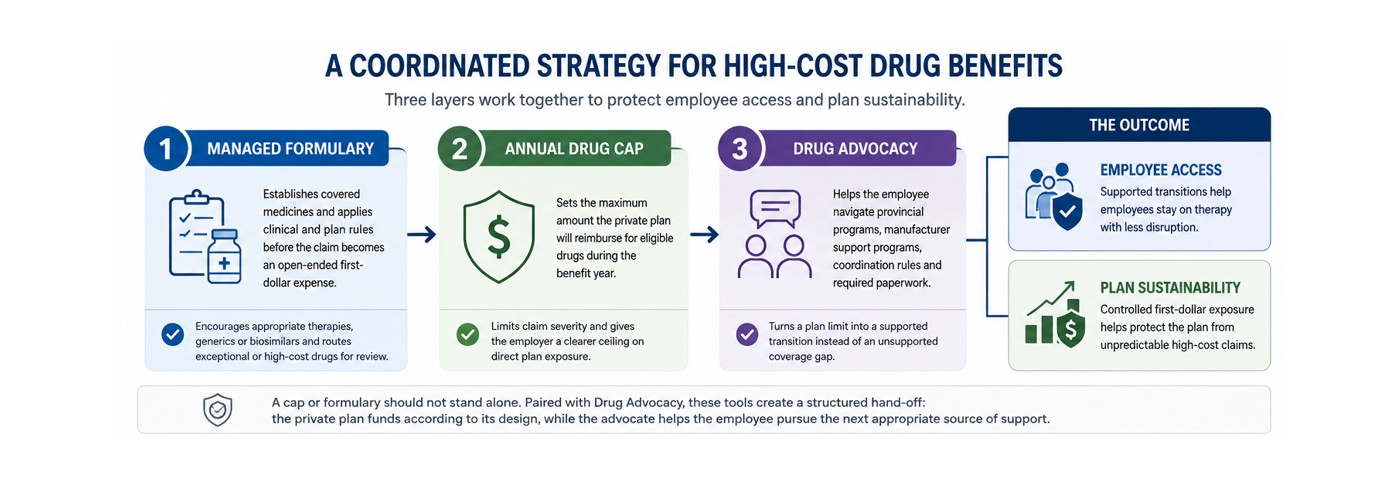
The model described in the source document has three coordinated layers: managed formulary, annual drug cap and Drug Advocacy. The table on page 2presents these components as a single strategy rather than independent cost controls.
Layer 1: Managed Formulary
A managed formulary determines which medicines qualify for coverage and what clinical or plan rules apply.
Depending on the plan, this process may encourage appropriate therapies, generics or biosimilars where available and route exceptional or high-cost medications through an appropriate review process.
The objective is not simply exclusion. It is to establish a structured process before a high-cost medication becomes an open-ended first-dollar obligation for the plan.
Layer 2: Annual Drug Cap
An annual drug cap establishes the maximum amount a private benefits plan will reimburse for eligible prescription drugs during a benefit year.
The original Beneplan material identifies examples such as $5,000, $10,000 or $15,000, depending on plan design.
The appropriate amount cannot be determined from a generic benchmark alone. Employer size, workforce requirements, risk tolerance, plan terms and other considerations should inform the decision.
Layer 3: Drug Advocacy
The third layer is what distinguishes a coordinated approach from simply imposing a maximum.
When an employee approaches a drug cap or encounters a medication that is not eligible for first-dollar coverage, advocacy helps the member investigate the next appropriate pathway.
Depending on the circumstances, that could involve provincial coverage, manufacturer assistance, patient-support programs or coordination between different funding sources.
The cap defines the plan's exposure; advocacy supports the member through what comes next.
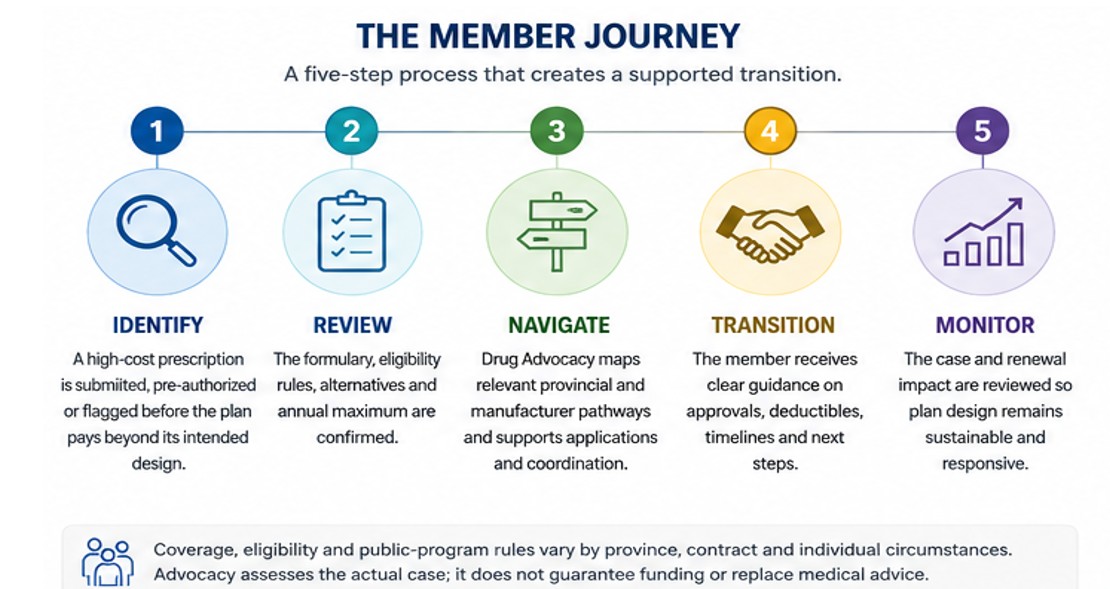
How Does the Member Journey Work?
This structure turns an otherwise abrupt coverage limit into a managed process.
How Can Public and Private Drug Coverage Work Together?
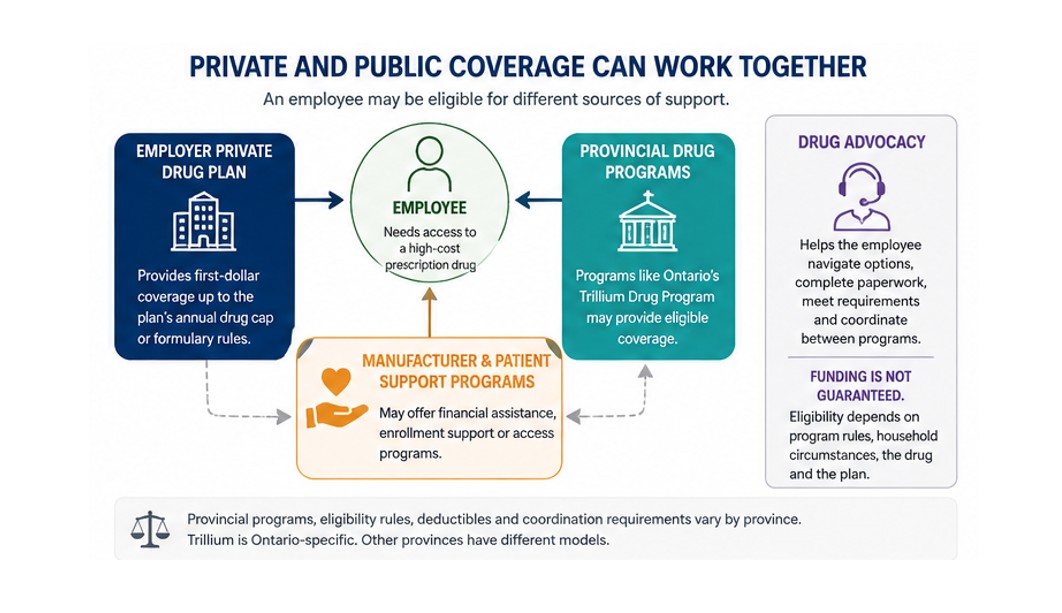
Canada does not have one uniform drug-funding pathway for every employee.
Provincial drug programs have different eligibility criteria, deductibles, covered medicines and coordination requirements. Manufacturer and patient-support programs can also have their own conditions.
That means plan sponsors should avoid assuming that a funding model that works in one province will work identically elsewhere.
Drug Advocacy assesses the actual member situation and available pathways rather than treating alternative funding as automatic.
Illustrative Ontario Example: Trillium and a $30,000 Drug Claim
The source article provides an illustrative, rather than guaranteed, scenario involving a $30,000 annual specialty-drug claim and an 80% private plan.

The example illustrates the potential role of coordination between private coverage, plan design and Ontario's Trillium Drug Program.
It should not be interpreted as a universal outcome.
Actual costs and funding depend on factors such as household circumstances, program eligibility, plan provisions and drug-specific requirements. Trillium is also Ontario-specific; other provinces operate under different models.
Why Shouldn't a Drug Cap Stand Alone?
A drug cap can control financial exposure, but a cap by itself does not tell an employee how to obtain support for medication costs above the plan maximum.
That is why the source material emphasizes pairing caps and formularies with Drug Advocacy.
The three components perform different functions:
The formulary reviews. The cap limits. The advocate navigates.
Together, they can create a structured hand-off from the private plan to other appropriate funding pathways rather than leaving the employee to research a complex system alone.
This approach also gives employers an alternative to responding to high-cost claims only through broad, workforce-wide benefit reductions.
What Should Employers and Benefits Advisors Consider?
High-cost drug planning is most useful when it happens during plan design and renewal rather than after a significant claim has already affected experience.
Employers and advisors should consider whether their current benefits strategy clearly defines high-cost drug coverage and what happens when an employee reaches a limit.
Communication is equally important.
Employees should understand not only that a cap or formulary exists, but also where they can obtain confidential support if a medication is affected.
Provincial differences also require attention. A strategy designed around an Ontario program should not automatically be presented as applicable to employees elsewhere in Canada.
Five Questions to Ask During Every Drug Plan Review
Before renewal, plan sponsors can use these five questions from the source document as a practical framework:
1. Does the plan use a managed formulary? Determine how specialty drugs, biosimilars and exceptions are handled.
2. What annual drug cap is appropriate? Consider employer size, workforce needs, risk tolerance and plan design.
3. What happens when an employee approaches the maximum? There should be a defined process rather than an unexpected stopping point.
4. Who coordinates other funding pathways? Establish who will help navigate public programs, manufacturer assistance and documentation.
5. How will the strategy be communicated? High-cost drug situations involve personal health information and should be handled confidentially and compassionately.
These questions shift the conversation from reacting to claims toward proactively designing a sustainable process.
Frequently Asked Questions
What is a high-cost drug benefit strategy?
A high-cost drug benefit strategy helps employer-sponsored plans manage expensive prescription claims while supporting member access. It may combine managed formularies, annual drug maximums, prior authorization and member advocacy so the plan can balance appropriate coverage with long-term financial sustainability.
What is a managed drug formulary?
A managed formulary defines which medicines are eligible for coverage and what clinical or plan rules apply. It may route specialty or high-cost medications through additional review and encourage appropriate alternatives, including generics or biosimilars where available.
What is an annual drug cap?
An annual drug cap is the maximum amount an employer’s private benefits plan will reimburse for eligible prescription drugs during a benefit year. The amount depends on the specific plan contract and design.
What happens when an employee reaches a drug cap?
The next steps depend on the plan, the drug and the employee’s circumstances. In a coordinated advocacy model, the employee can receive help exploring provincial programs, manufacturer or patient-support programs and other legitimate funding pathways. Eligibility and funding are not guaranteed.
Can Drug Advocacy guarantee that another program will pay?
No. Funding depends on program eligibility, provincial requirements, the prescribed drug, household or individual circumstances and other applicable rules. Advocacy can help members understand and navigate the process, but it cannot guarantee approval or reimbursement.
Does Ontario’s Trillium Drug Program apply across Canada?
No. Ontario’s Trillium Drug Program is specific to Ontario. Other provinces have their own drug programs, eligibility requirements, deductibles and coordination arrangements. A high-cost drug strategy should therefore account for where each employee lives.
Why combine a formulary, drug cap and advocacy?
Each solves a different part of the problem. The formulary establishes coverage rules, the cap defines the private plan's maximum exposure, and advocacy helps the employee navigate potential next-step funding options.
When should employers review their high-cost drugs strategy?
Ideally, employers and benefits advisors should review the strategy during plan design and renewal rather than waiting until a high-cost claim occurs. The review can consider formulary rules, maximums, member support, provincial differences and communication procedures.
Conclusion: Build the High-Cost Drug Strategy Before the Claim
Managing high-cost drug benefits does not have to mean choosing between employee access and plan sustainability.
A coordinated approach can establish clear boundaries for private-plan exposure while providing employees with support when they need to navigate other funding pathways.
Beneplan's model combines managed formularies, annual drug caps and hands-on Drug Advocacy. The objective is to make the transition beyond first-dollar private coverage structured and supported rather than leaving employees to navigate complex funding systems independently.
For employers and advisors, the most important time to have this conversation is before the high-cost claim arrives.
*This content is for benefits-planning information and discussion, not medical advice. Coverage, clinical appropriateness, reimbursement and funding eligibility depend on applicable plan contracts, government or program rules and individual circumstances.


